

Tesollo Robotic Hand Adopted as a Research Platform at Stanford University
- Invited seminar held at MIT to introduce Tesollo’s robotic hand technology
- From MIT to Stanford… Expanding presence across leading global research institutions
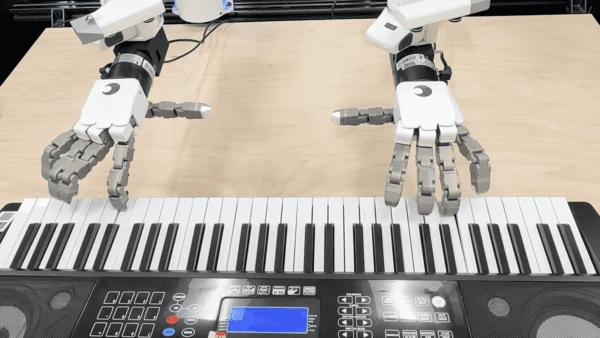
Tesollo’s multi-jointed robotic hand is being used as an experimental platform at leading research institutions worldwide, helping introduce the company’s technology and real-world applications to the global research community.
Following the adoption of Tesollo’s “DG-5F-M” in advanced robot learning research at Stanford University, the Massachusetts Institute of Technology (MIT) also hosted an invited seminar introducing Tesollo’s robotic hand technologies and related applications.
In recent years, universities and research institutions around the world have increasingly pursued dexterous manipulation research using robotic hands. According to a bibliometric analysis based on Web of Science published in 2025, the number of papers related to grasping and control using multi-jointed robotic hands increased from approximately 10 papers in 2008 to more than 30 papers annually after 2016. Research topics have also evolved from basic grasping to more advanced areas such as in-hand manipulation, bimanual collaboration, multimodal sensing, reinforcement learning, and real-world robotic applications.
Stanford researchers used Tesollo’s 20-DoF robotic hand, the “DG-5F-M,” in the HandelBot and DexDrummer projects released in 2026. HandelBot is a project that demonstrated bimanual piano playing using two DG-5F-M robotic hands and Franka robotic arms. Using approximately 30 minutes of real-world interaction data, the system performed five songs and achieved 1.8 times higher performance than an approach that directly transferred a simulation policy to a real robot.
DexDrummer validated in-hand manipulation, repeated external contact, and long-horizon motion control through robotic drumming. A policy that actively controlled the fingers achieved F1 scores 1.87 times higher on easier songs and 1.22 times higher on more difficult songs compared with a fixed-grasp approach.
While the Stanford projects demonstrated the use of Tesollo products to validate advanced robot learning technologies on real hardware, the MIT seminar represented an invited technical presentation introducing Tesollo’s robotic hand technologies and application cases to the global research community. Tesollo CTO Wooseok Ryu was invited as a speaker at MIT’s Optics and Quantum Electronics Seminar on May 27, where he presented high-DoF robotic hands and actuators, AI-based control technologies, and related application cases. The seminar provided an opportunity to share technical perspectives on the future development of robotic hand technologies.
As research results, papers, videos, and code have been made publicly available, use cases of the DG-5F-M are expanding beyond individual laboratories and becoming practical references that researchers around the world can access. This demonstrates that Tesollo’s robotic hand is being used not merely as a finished hardware product, but as a research platform for validating new control algorithms and robot learning technologies in real-world environments.
In particular, as robotic hand research expands from basic grasping to bimanual collaboration, in-hand manipulation, long-duration tasks, and multimodal sensing, not only the number of degrees of freedom but also control precision, repeatability, durability, and software integration are becoming increasingly important factors that influence research outcomes. To respond to these research demands, Tesollo plans to continue improving both hardware and software performance while expanding opportunities for technical exchange and product validation with universities and research institutions.
Tesollo is building a virtuous cycle that extends from product supply to real-world research use, publication of research outcomes, and technical exchange with the global research community. Going forward, the company plans to provide a research foundation that enables leading universities and research institutions worldwide to develop and validate robot learning and dexterous manipulation technologies, while further strengthening its technological credibility and presence within the global robotics research ecosystem.
Source: The Robot News (https://www.irobotnews.com)