
DS-Dual Arm
Dual-Arm Robot Teleoperation and Manipulation Data Collection Solution
Dual-Arm Robot Teleoperation & Manipulation Data Collection Solution
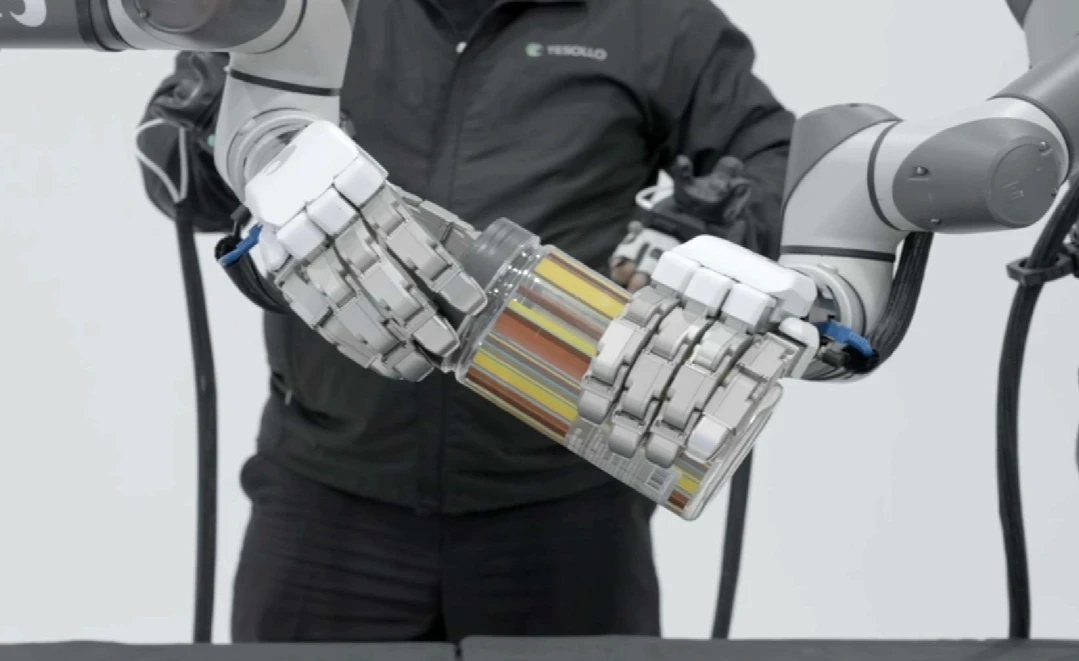
DS-Dual Arm is a teleoperation solution that maps an operator’s hand and arm movements to a dual-arm robot and articulated robotic hands in real time, enabling complex manipulation tasks to be reproduced by the robotic system.
Using data gloves and trackers, the system captures finger movements as well as the position and orientation of both arms and converts them into robot motions, enabling bimanual coordination, object manipulation, assembly and disassembly, tool use, and other complex tasks.
Manipulation inputs and robot motion data generated during operator demonstrations can also be collected and used for robot manipulation AI dataset development, task validation, Imitation Learning, and VLA model research.
Reproduce Human Bimanual Motion on Robots in Real Time
Implementing complex manipulation tasks on robots often requires significant time and effort to manually program individual motions or define task-specific trajectories.
DS-Dual Arm enables the operator’s hand and arm movements to be mapped directly to the robot in real time, providing a more intuitive way to generate complex robotic motions.
By capturing not only arm position and orientation but also finger movements, the system can reproduce not only basic robot arm motion but also grasping, object reorientation, bimanual coordination, and contact-rich manipulation tasks.

Data Collection for Robot Manipulation AI
DS-Dual Arm is designed to collect both human manipulation inputs and robot motion and state data while reproducing operator demonstrations on the robotic system.
A complete sequence of human actions—from approaching and grasping an object to manipulating it—can be recorded as robot data and used as Demonstration Data for training and validating robot manipulation models.
When required, vision systems can be added to the robot wrists or workspace to create multimodal datasets combining visual information with robot state and manipulation data.
Key Data Collected
- Operator finger and hand movements
- Position and orientation of both hands and arms
- Robot arm position, orientation, and motion data
- Robotic hand joint and grasping data
- Task state and manipulation data
- Task videos and visual data when integrated with vision systems
Complex Manipulation Through Bimanual Coordination
Many real-world manipulation tasks involve more than simple one-handed Pick & Place. They require both hands to simultaneously grasp, support, move, and coordinate interactions with objects.
DS-Dual Arm controls a dual-arm robot together with left and right articulated robotic hands, providing an environment for reproducing and researching complex manipulation tasks that require bimanual coordination.
The system can be applied to a wide range of Bimanual Manipulation Tasks, such as holding an object with one hand while manipulating it with the other, or handling a single object with both hands simultaneously.
Application Examples
- Bimanual coordinated object manipulation
- Component assembly and disassembly
- Object handover and reorientation
- Tool-use tasks
- Contact-rich manipulation
- Manipulation of unstructured objects
- Robot motion generation from operator demonstrations
Robot AI Research & Dataset Developmen
Developing robot manipulation AI requires high-quality Demonstration Data based on diverse tasks performed by humans in real-world environments.
With DS-Dual Arm, operators can directly control the robotic system and repeatedly collect task demonstration data, which can be used to train and validate various robot manipulation models, including Imitation Learning, VLA, and Manipulation Policies.
New tasks can also be demonstrated and repeatedly evaluated on a physical robotic system, making DS-Dual Arm a research platform for developing robot manipulation algorithms and improving their performance.
Application Examples
- Robot Manipulation Dataset development
- Imitation Learning
- VLA-based robot manipulation research
- Manipulation Policy training
- AI model performance validation
- Feasibility testing for new robotic tasks
Real-Time Mapping of Hand and Arm Movements
Data gloves and trackers measure the operator’s finger movements and the positions and orientations of both arms, converting and mapping them to the movements of a dual-arm robot and robot hands in real time.
Complex robot motions can be generated directly from the operator’s movements, reducing the need to program each robot motion individually.
Manipulation Through Bimanual Coordination
The system controls the left and right robot arms together with articulated robot hands, enabling tasks such as grasping an object with one hand while manipulating it with the other or handling a single object with both hands simultaneously.
Beyond simple Pick & Place operations, it can be used for a wide range of bimanual Manipulation Tasks, including assembly, disassembly, tool use, and object reorientation.
Human-Robot Manipulation Data Collection
Data generated during human demonstrations can be collected by linking the operator’s manipulation inputs with the robot’s movements.
The system records the operator’s hand and arm movements together with robot arm and robot hand state information, providing data for building robot manipulation datasets and training AI models.
Multimodal Data Expansion Through Vision Integration
If required, a vision system can be added to the robot wrist or workspace to collect visual information about the work environment and objects.
Vision Data, Robot State, Hand Motion, and other data can be integrated to create datasets for research on VLA and multimodal robot manipulation models.
Integrated Teleoperation, Data Collection, and Robotic System
S-Dual Arm is more than a simple teleoperation device. It is an integrated solution combining the Operator Interface, control system, dual-arm robot, and articulated robot hands required for real-world bimanual robotic manipulation.
Human Motion → Motion Tracking → Motion Mapping → Robot Control → Manipulation → Data Collection
The entire process—from operator motion input and robot motion generation to task execution and data collection—is implemented as a single system.