

Tesollo Expands from Grippers to Humanoid Hands Through Joint Modularization
- Multi-jointed robotic hands replacing human hands move from research equipment to mass-production lines
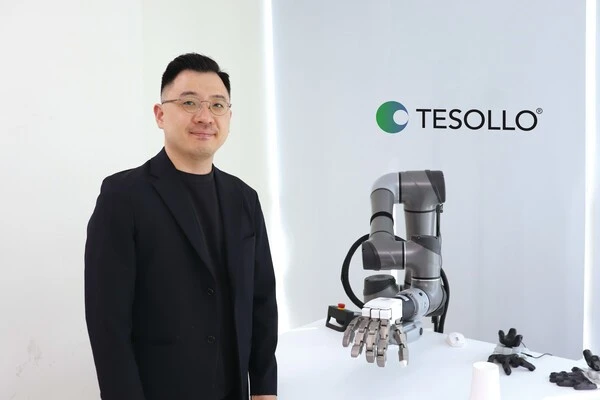
Tesollo, a company specializing in robotic grippers and robotic hands, is working to establish references for applying multi-jointed robotic hands to mass-production lines. The company has completed demonstrations in one-kit processes connecting logistics warehouses and assembly lines and is now moving toward deployment in mass-production processes. For processes that require manipulation after grasping, such as assembly and packing, Tesollo is conducting functional verification with customers in the form of proof-of-concept (PoC) projects.
Founded in 2019, Tesollo specializes in robotic end-effectors. The company develops and manufactures multi-jointed robotic grippers and humanoid robotic hands, and has secured its own technologies in multi-joint actuation mechanisms, modular actuators, control circuits, firmware, and manipulation.
Tesollo currently offers the Delto Gripper product line, ranging from one-finger to five-finger models with different numbers of fingers and degrees of freedom. The company supplies products and solutions not only for manufacturing automation but also for logistics, research and development, AI training, and humanoid robotics.
Seven Years of Transformation from Circuit and Control Technology to a Manufacturing Company
Tesollo began with electrical systems and control technologies for robot actuation. In its early days, the company’s R&D focused on circuit design and control algorithms, and as it sought to turn accumulated technologies into products, it chose robotic end-effectors as its direction.
The company’s identity changed significantly in 2022 when it began full-scale commercialization of multi-jointed grippers. Today, its R&D organization consists of a hardware design team, circuit design team, and AI & solutions team, which work closely together.
This organizational structure reflects the fact that a robotic hand cannot be realized through hardware alone. Low-DoF grippers generally perform only opening and closing motions and therefore require relatively little dedicated control technology. However, as the number of joints increases, performance differences emerge depending on the control method.
Ryu said, “If you develop a robotic hand capable of 20 different movements and then tell customers to develop the control system themselves, no one will buy it.” According to Ryu, the level of precise control that can be achieved and the sophistication of the algorithms that can be applied are largely determined from the circuit-design stage.
Robotic Hand Market Segmented by Actuation Method
Robotic hands can broadly be divided into three categories based on how actuation force is transmitted to the joints: tendon-driven systems that pull cables, linkage-driven systems that transmit force through combinations of links and gears, and direct-driven systems that integrate motors and reducers into each joint.
In the first two approaches, actuators are positioned in the palm or arm and force is transmitted through an intermediary mechanism. In a direct-driven system, the actuator is integrated directly into the joint itself. Ryu estimated that cable-driven systems account for approximately 70% of the market, linkage-driven systems around 15%, and direct-driven systems around 15%. Tesollo has adopted a direct-driven architecture.
Each actuation method faces different challenges as it evolves. Cable-driven systems must improve cable durability and maintainability while securing materials that resist stretching. Direct-driven systems, meanwhile, must miniaturize actuators concentrated within the joints and suppress heat generation.
“The three approaches each have different advantages and disadvantages, so I do not expect them to converge into a single architecture,” Ryu said. “The choice depends on which performance characteristics the designer prioritizes and which market the product is intended to serve.”
The advantages of the direct-driven structure lie in independent control of each joint and precise state feedback. Systems that transmit actuation force through intermediaries such as tendons or linkages may experience motion coupling, where the movement of one joint affects another due to structural characteristics. In addition, as the distance between the actuator and joint increases, errors in repeatability can accumulate due to deformation or backlash in the transmission system.
By contrast, direct-driven systems place the actuator directly at each joint, minimizing the influence of transmission mechanisms and making it advantageous for achieving independent joint-level control and accurate state feedback.
“Each joint is controlled by its own motor, making independent actuation possible,” Ryu said. Feedback on external forces can also be obtained immediately at the individual joint level. This is one of the reasons Tesollo offers tactile sensors as an option rather than as a standard feature.
Tesollo’s hands are controlled by receiving current feedback from each joint and converting it into force. Most products currently deployed in automation processes operate without additional sensors.
Product Lineup from One to Five Fingers Based on Joint Modularization
Tesollo’s design principles are quality, manufacturability, scalability, and maintainability. The structure that reflects these principles is joint modularization. By designing each joint as a standardized independent module, common components can be shared across different products, and if a specific joint develops a problem, only that module can be replaced without disassembling the entire robotic hand.
“If you have the capability to manufacture modules with consistent performance, quality can be maintained because every joint uses the same module,” Ryu said. “The more modules you mass-produce, the more unit costs can be reduced and the more production capacity can be secured.”
The product lineup is categorized according to the number of fingers, degrees of freedom, and installation environment.
The DG-5F-M is a 20-DoF robotic hand similar in size to an adult male hand, with four degrees of freedom per finger and a product weight of 1,763 g. Its rated pinch-grip payload is 2.5 kg, with a maximum of 5 kg, while its rated enveloping-grip payload is 10 kg, with a maximum of 20 kg.
The DG-5F-S applies a lightweight design of less than 1 kg to the same 20-DoF structure. It weighs 880 g and has a control cycle of 500 Hz.
The DG-4F is an 18-DoF model capable of performing left-hand, right-hand, and gripper functions, while the DG-3F-M features a 12-DoF, three-finger structure with a modular design optimized for industrial environments. The DG-2F has six degrees of freedom, while the DG-1F is a vacuum gripper that adds three degrees of freedom to a suction pad.
The benchmark for setting specifications is manual human work. Because required specifications vary significantly depending on the industry and process, Tesollo uses human hand size, practical loads of around 5 kg, and durability for long-term operation as its design criteria.
“People cannot continuously hold 5 kg for 24 hours either,” Ryu said. “We also receive inquiries requesting high payloads, but these require separate development, so we are not currently addressing them.”
Domestic Demand Led by Automotive and Home Appliances, Overseas Demand Led by AI and Humanoids
In South Korea, the manufacturing industry has been the first to respond. Inquiries continue to come from the automotive, home appliance, and semiconductor sectors, with the automotive industry showing the strongest interest.
The processes being targeted involve handling multiple objects of different shapes with a single end-effector. A representative example is the one-kit process, in which the parts required for an assembly line are grouped together in advance.
Since assembling a single automobile requires a large number of different parts, workers have traditionally been responsible for taking the required quantity of each component from separate boxes and combining them into kits. Bin picking and piece picking fall into the same category.
Ryu explained that the true capabilities of a multi-jointed structure emerge after grasping. To expand into tasks such as connector insertion or packing, the hand must be capable of in-hand manipulation, which changes the orientation of an object within the hand. This area is still at the PoC stage, with functional verification currently underway.
There is also demand from the food & beverage and service industries, but they come later in terms of market entry. This is because additional requirements must be met, including hygiene regulations, waterproof and dustproof certifications, and resistance to oil vapor.
The structure of overseas demand differs from that of the domestic market. Last year, overseas sales exceeded domestic sales, with most revenue coming from five-finger products. Major customers are AI companies and humanoid robotics companies. Tesollo products have been supplied to more than 20 countries, including the United States, Europe, Japan, China, India, and the Middle East.
The reason five-finger structures are required lies in training data. “To directly apply data obtained from human movements, you need a hand with five fingers,” Ryu explained. Three-finger products may be more efficient in terms of functionality and price, but transferring data collected from humans to a three-finger structure results in losses during the mapping process.
There are also differences in collaboration models between domestic and overseas companies. Domestic humanoid companies tend to pursue in-house development even for robotic hands, whereas overseas companies often prefer division of labor.
“Overseas companies approached us from the beginning with the idea that each party should focus on what it does best and collaborate,” Ryu said. However, some Korean companies have recently begun choosing external robotic hands while developing their own manipulators in-house.
In terms of competition, Ryu is paying close attention to China. As Physical AI gained momentum in 2025 and the humanoid market expanded, awareness of the importance of hands as robot end-effectors grew. From the second half of the year, numerous robotic hand products were launched in China, including a growing number of companies adopting direct-driven architectures similar to Tesollo’s.
Ryu said the United States and China have taken different approaches. While the U.S. has focused on advancing algorithms, China has placed greater emphasis on hardware performance and is narrowing the algorithmic technology gap by leveraging data generated in its domestic market.
The Next Step: Establishing Mass-Production Application References
Tesollo’s next goal is to establish references on mass-production lines. Multi-jointed robotic hands are spreading rapidly in R&D and demonstration environments, but there are still relatively few cases in which they have been deployed at scale in core mass-production processes.
In the short term, Tesollo plans to establish demonstration references primarily in processes that remain highly dependent on manual labor, such as assembly, packing, and irregular-part handling. It then plans to verify durability, task success rates, productivity, and maintainability through repeated operation and connect those results to deployment on mass-production lines.
Tesollo is focusing on securing such references because once stable operation is confirmed in one process, the solution can be expanded to similar processes.
From a technology perspective, Ryu expects the next one to two years to be a period of rapid advancement in manipulation algorithms.
“Going forward, the ability to use visual and tactile information together to understand the state of an object, change the pose of a grasped object, or perform precision assembly will become increasingly important,” he said.
He also expects advances in imitation learning, reinforcement learning, and teleoperation-data learning to shorten the amount of time robotic hands need to acquire new tasks.
Ryu expects robotic hands to increasingly be supplied not as standalone components, but as general-purpose manipulation solutions integrated with humanoid arms and perception, decision-making, and action systems.
Tesollo is advancing its hardware and software architecture to enable integration with a wide range of humanoid platforms, while also providing SDKs and software interfaces that allow developers to control its products according to their own robot platforms and research environments.
“We want Tesollo itself to create globally recognized mass-production application cases for multi-jointed robotic hands,” Ryu said.
Source: Industry News (https://www.industrynews.co.kr)