

‘Korean Robot Company of the Year 2025’ Awards Held… All the Star Companies Gathered
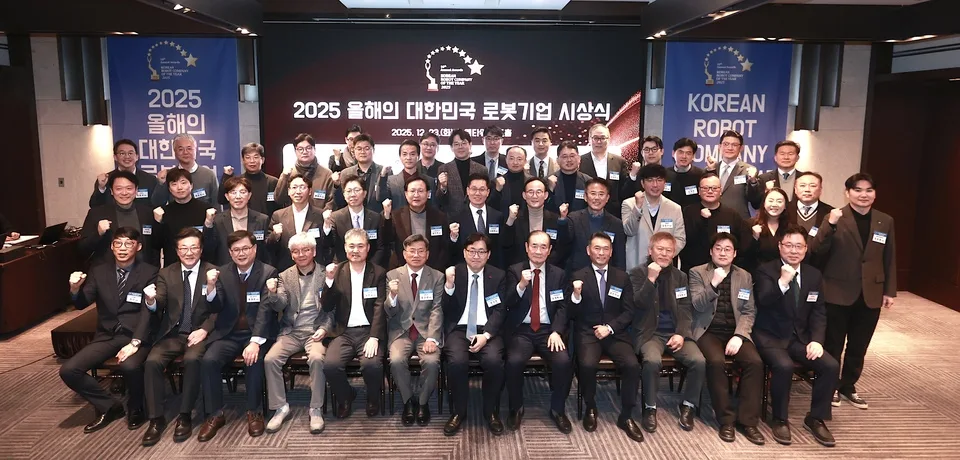
Korea’s leading robot companies, selected by Robot Newspaper—the country’s only robot-dedicated media outlet—gathered in one place. The award-winning companies looked back on their achievements over the past year, pledged stronger ecosystem building and cooperation, and reaffirmed their commitment to a new leap forward in 2026.
On the 23rd, Robot Newspaper hosted the “Korean Robot Company of the Year 2025” awards ceremony and a CEO roundtable at the Gold Hall of EL Tower in Yangjae-dong, Seoul. The event was attended by robot company CEOs as well as representatives from relevant associations and organizations.
The “Korean Robot Company of the Year” recipients were selected through a comprehensive evaluation of each company’s contributions to the development of Korea’s robotics industry in 2025, future growth potential, CEO leadership and management capability, new product launches, and market performance. A total of 39 companies were recognized across seven categories: Industrial Robots, Professional Service Robots, Personal Service Robots, Robot Parts/Devices, Robot Software/Platforms, Robot AI, and Robot System Integration (SI).
This year marked the 10th anniversary of the awards since their launch in 2016. Yujin Robot set a major record by winning for the 10th time and became the first Korean robotics company to be inducted into the “Hall of Fame,” receiving a special commemorative plaque.
Neuromeka was honored for nine consecutive years of recognition since 2017, and Doosan Robotics received the award for eight consecutive years. Along with T-Robotics, which won for the eighth time, companies such as Syscon Robotics, SPG, Higen RNM, SBB Tech, and Wonderful Platform reinforced their standing as multi-year award winners by receiving their seventh awards.
In addition, 10 companies—Robostar, Yuil Robotics, Hurim Robot, Daedong Robotics, Makeware, A-Robot, Cosmo Robotics, CaseLab, Jugang Robotech, and Tesollo—were recognized as winners for the first time.
Ryu Ji-ho, Acting President of the Korea Institute for Robot Industry Advancement (Head of the Manufacturing Robot Division), delivered a congratulatory address, saying, “I extend my sincere congratulations to the representatives and employees of the award-winning companies. Even amid an uncertain economic environment, your continuous innovation and spirit of challenge have elevated the standing of Korea’s robotics industry.” He added, “Your achievements are becoming a strong cornerstone not only for individual company growth but also for Korea’s leap toward becoming a robotics powerhouse.” He also noted that the public and private sectors will work together to strengthen the ecosystem, improve regulations, and create market opportunities through field demonstrations so that the robotics industry—at a major turning point in the AI-robot era—can lead the global market.
Jo Gyu-nam, CEO and Publisher of Robot Newspaper, encouraged the winners, stating, “I express my heartfelt gratitude to the award-winning companies that have remained dedicated to advancing Korea’s robotics industry despite difficult conditions this year.” He noted that among the 39 selected companies, 18 are publicly listed and many more are preparing for an IPO next year, indicating that Korea’s robotics industry is growing both in scale and in quality. He emphasized that, in order to demonstrate true competitiveness against the United States and China in technology, price, scale, and speed, both government and industry must work together to grow the sector. He also said Robot Newspaper will continue to serve the ecosystem by publishing its weekly “Robot Plus” and, next year, by organizing a robotics CEO forum and covering robotics events in Korea and abroad.
[Korean Robot Company of the Year 2025]
Category — Award Winners
Industrial Robots: Now Robotics, Neuromeka, Doosan Robotics, Raon Tech, Robostar, Yuil Robotics, LPK Robotics, T-Robotics, Hurim Robot Professional Service Robots: Koh Young Technology, Daedong Robotics, Robotis, Robot & Design, Mobius, Makeware, Syscon Robotics, Yujin Robot, A-Robot, Cosmo Robotics, Curexo, CaseLab, Twiny, Tira Robotics Personal Service Robots: RoboCare Robot Parts/Devices: RS Automation, SBB Tech, SPG, Aidin Robotics, UND, Jugang Robotech, Tesollo, Welcon Systems, Higen RNM Robot Software/Platforms: Bigwave Robotics, Cmes, Clobot Robot AI: Wonderful Platform Robot SI (System Integration): Geon Solution, Brills
During the CEO roundtable held after the ceremony, participants discussed proposals and public–private cooperation measures to support the development of Korea’s robotics industry in 2026, including training specialized talent, expanding into global markets and addressing regulations, strengthening localization of components and ecosystem development, and improving public awareness.
Kim Byung-jae, Vice President of Geon Solution, expressed difficulties in securing talent for technology development amid shifting industrial paradigms and emphasized the need for government support to attract and cultivate skilled professionals.
The importance of cooperation and support for global expansion by Korean robotics companies was also raised. Kim Won-kyung, CEO of Raon Tech, said that cooperation among Korean companies is critical to secure competitiveness in the face of U.S. and Chinese competition, and suggested efforts to enter overseas markets quickly by combining solutions with partner companies where appropriate.
Hwang In-joon, Executive Director of Koh Young Technology, noted challenges in early-stage market establishment overseas and called for expanded policy and legal support. Bae Byung-joo, CEO of Robostar, said that as domestic investment has decreased, many companies are looking overseas and that support for export-related systems such as international safety certifications would be helpful.
Kim Byung-woo, Executive Director of Daedong Robotics, highlighted that it can be difficult to track regulatory and legal trends by country, particularly in agriculture, and suggested that support organizations could provide relevant information and guidance. Kim Hyun-soo, Managing Director of Doosan Robotics, also emphasized the need to pay close attention to safety certifications to support wider adoption of intelligent robots and humanoid robots.
Lee Cheol-soo, CEO of UND, remarked that the market remains challenging, saying that there is often “a lot of buzz but not enough orders,” and emphasized the need for government policy and support as a catalyst to achieve economies of scale and competitiveness. He also noted that logistics costs can be significant for small-volume overseas shipments and called for policy attention to help address this burden.
The dilemma between adopting domestic components and maintaining price competitiveness was also discussed. Yeo Young-gil, CEO of SPG, pointed out that Korea’s robotics revenue remains under 100 billion KRW and emphasized that, despite strong quality, domestic components are sometimes avoided due to cost pressure—leading some companies to import parts or manufacture overseas. He called for measures that enable broader use of domestic components to support mutual growth across the ecosystem. Lee Yoon-haeng, CEO of Aidin, also stressed the need for support for a domestic component ecosystem that can compete with Chinese products.
Eom Yoon-seol, CEO of A-Robot, shared that about 60% of his company’s humanoid components are domestic largely because they produce many parts in-house, adding that it is difficult to withstand aggressive price competition. He proposed “win-win” policies such as subsidies for humanoid manufacturers that adopt domestic components to encourage coexistence between robot makers and component suppliers.
Ryu Jae-wan, CEO of SBB Tech, and Jo Dong-il, CSO of RS Automation, reaffirmed their intention to pursue joint growth and market development through the Robot Components Companies Council.
Ryu Ji-ho said that although component subsidies face practical limitations, the institute will continue collecting feedback. He also encouraged companies to actively use the Korea Institute for Robot Industry Advancement as a platform in connection with next year’s robotics support budget of 200 billion KRW.
Jeon Jin, CEO of Brills, noted that Korean robotics companies sometimes engage in excessive “chicken-game” competition in a small domestic market and emphasized the need for government support and corporate efforts to expand overseas and accelerate robot automation adoption among small and medium-sized enterprises. Kim Min-gyo, CEO of Bigwave Robotics, added that robot adoption can expand across many areas including SMEs and that optimized targeting and approaches are needed for different customer segments.
Park Jong-hoon, CEO of Neuromeka, said that while the future value of robotics is increasing, many companies still struggle in real business settings, and suggested that more opportunities to share root causes and solutions would be beneficial. He also suggested that RobotWorld, despite growing in scale, should consider more substance and thematic depth.
Sim Tae-ho, CEO of LPK Robotics, emphasized the importance of finding win-win solutions through collaboration rather than each company trying to survive alone. Kim Dong-kyung, CEO of Tira Robotics, said that “sovereign robots” are important much like “sovereign AI,” and stressed the need for ecosystem cooperation to maintain leadership in robotics.
Kim Chang-gu, CEO of Clobot, said that the robotics industry still requires significant effort in revenue and profitability, but expressed optimism that next year may be more promising even though service robots did not meet expectations this year.
Lee Sun-young, Director at Robotis, cited cases such as police reports being filed when outdoor delivery robots operate in public spaces, emphasizing that beyond technological advancement, a shift in social perception is necessary so public officials and citizens can accept robots as partners in everyday life.
Kim Jong-won, Head of the Investment Attraction Division of Daegu Metropolitan City, promoted Daegu’s strong infrastructure such as a national robot test field and encouraged corporate interest and investment.
Park Il-woo, Program Director at the Korea Institute of Industrial Technology Planning and Evaluation, explained that next year’s robotics R&D programs will be driven by two major directions: “AI robots” and “collaboration between manufacturing companies and component suppliers.”
Meanwhile, Kim Young-je, Project Manager at the Korea AI Robot Industry Association, introduced the association’s programs and member support initiatives, and also presented the “2026 RoboCup” event scheduled for next July.
Source: Robot Newspaper (https://www.irobotnews.com)